
AI Concierge vs Chatbot vs Voice AI: The Taxonomy Enterprise Buyers Need
Three different categories are being sold under one name. Here is what actually separates them, and what enterprise buyers should ask before they sign.
Origa Team
Product & GTM
We spent the last few weeks surveying the agentic AI space, around how it’s being adopted across enterprises vs what was initially promised. The distance between those two answers turned out to be a story we wanted to share.
We started with two numbers from Gartner's July 2026 release, which forecasts a case where AI agents will outnumber sellers ten to one. What’s more - fewer than 40% of sellers will say those agents made them any more productive.
Gartner has a name for this space in between: agent sprawl. It’s attributed to more digital activity, net-zero impact.
The easy read here is that the technology underdelivered. The harder read is that nobody could tell what they were buying. Gartner named that one too, a year earlier.
Agent washing: the rebranding of assistants, robotic process automation and chatbots as agentic AI, with none of the capability underneath. Of the thousands of vendors claiming the label, Gartner estimated around 130 were building the real thing. The same research put more than 40% of agentic AI projects on track for cancellation by the end of 2027.
So if you are sitting across from four vendors who describe themselves in the same eight words, the problem is not that you are being slow. You’re being asked to price a difference the language will fail to show you.
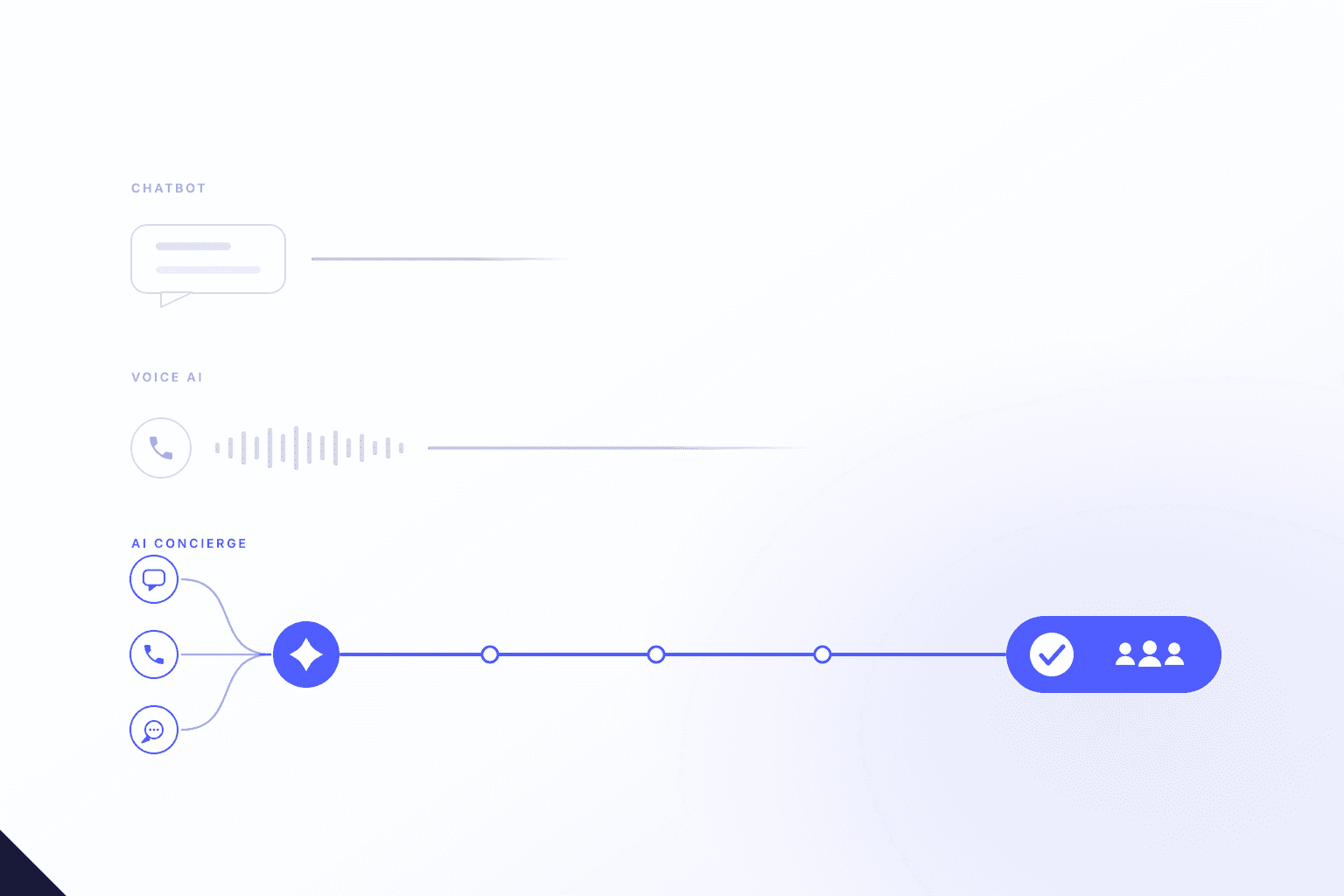
Here is the taxonomy, in the order the market built it
More in this guide:
- What is a chatbot?
- What is voice AI?
- What is an AI concierge?
- Why the distinction is important to enterprise buyers
- What an AI concierge looks like in production
- Four questions to ask any vendor before you decide to buy
Layer one: the chatbot
Job: deflection.
If there’s a chatbot on your site, it’s a great way to handle your biggest FAQs and redirect to helpful articles. Chatbots take care of limited tasks like answering basic questions, cancelling cards or opening service tickets. Memory ends when the window closes. Genuinely useful infrastructure, but not a contributor to the sales system because these are usually scripted or retrieval based, with one channel, one session.
Layer two: voice AI
Job: channel automation.
A voice AI agent is a step more advanced; it handles a spoken conversation end to end, at volume, at any hour. It’s extremely human-like and does great for engagement although the unit of value offered is really the call. No doubt an advancement on latency, natural turn taking and reach, and for high volume enquiry handling it’s the best there is. But the memory is still session bound. That means there’s a high chance you’d have to introduce yourself again..
Layer three: the AI concierge
Job: continuity.
The AI concierge layer encompasses all the three layers, since its unit of value is not the conversation but the memory that survives the conversation. An AI concierge holds one record of a buyer across voice, chat and WhatsApp, across weeks or months, and then briefs the human before the moment that decides the outcome.
This is not a marketing distinction. Research tells us that avoiding agent sprawl can come through with a centralised context layer connecting enterprise data, systems and seller judgement. It also ensures there’s instant solution resolution and gives users a reason to trust your brand more.
Organisations that overhaul data, automation and user experience will be five times more likely to gain ROI from AI than those choosing quick fixes.
In the blunter formulation: if the systems are fragmented, the agents will only scale that fragmentation.
| Chatbot | Voice AI | AI Concierge | |
|---|---|---|---|
| Primary job | Deflection | Channel automation | Continuity |
| Unit of value | The session | The call | The buyer relationship |
| Memory | Ends with the window | Ends with the call | Persists across channels and months |
| Channels | One, usually web | One, voice | Voice, chat and WhatsApp on one memory |
| Human handover | Transcript or ticket | Call recording | A brief: intent, history, objections, next action |
| Compliance | Prompt level | Prompt level | System level, with audit trail |
| Best fit | FAQs and support | High volume enquiry handling | High ticket, multi month, multi stakeholder |
Why the distinction is important to enterprise buyers
Because the failure it fixes is already measured. About 79% of customers expect consistent interactions across departments, yet 56% still need to repeat or re-explain themselves to different representatives and 55% feel they are dealing with separate departments rather than one company.
That gap has a price. Buyers want to self-serve the buyer journey and want a human at the decision. A chatbot cannot serve the first half. Voice AI cannot prepare the second. A concierge does both, because it remembers.
What an AI concierge looks like in production
Think of yourself as a buyer in each of these industries, and you’ll be able to visualize the workflow it represents.
- AI concierge for real estate: You’re enquiring about a property on a website, then call a hotline six weeks later, then drop a WhatsApp after a site visit. Three touches, one buyer, usually three cold starts. Now think of it as one memory, where the interaction starts with full context. That’s how we did for SP Setia, which now runs on an annual contract.
- AI concierge for education: Admissions cycles run across months, time zones and repeated re-explanation of the same profile. An AI-powered admissions companion that can qualify students based on eligibility criteria and help them choose the right program builds a unique student experience from the get-go.
- AI concierge for automotive: The automobile sector is probably one of the most interesting ones because car purchases are one that requires careful decision making. With Origa, you can automate the entire lifecycle from enquiry, test drive, finance, and delivery. Holding one memory across those four moments could potentially cut cost per qualified enquiry by over 60%.
- BFSI: Manage eligibility, documentation and compliance in a single thread, with guardrails at system level and a full audit trail rather than a prompt that can be talked around.
Four questions to ask any vendor before you decide to buy
- Does memory persist across channels and sessions, or reset at the end of each one?
- What does the salesperson actually receive at human handover? A transcript is not actually a brief.
- Are compliance rules embedded in the system, or written into a prompt?
- Does the deployment expand seller capacity, or simply add digital activity?
If a vendor cannot answer the first question, the other three probably do not matter.
The category you buy decides the outcome
Chatbots answer limited queries. Voice AI converses. An AI concierge converses, remembers, and hands your team a buyer they already know. As agents multiply ten to one against sellers, that difference stops being a feature comparison and becomes the whole return on the investment.
That’s what we’re building, feel free to explore more around what we do. We’d love to hear from you!
Frequently asked questions
Origa Team
Product & GTM
We survey the high-ticket sales market and publish what we find here. The rest of the time we build Origa, an AI concierge layer that holds one memory of every buyer across voice, chat and WhatsApp, and briefs the salesperson before they pick up. Antler-backed, with offices in Dubai and Bengaluru.