AI agent vs. AI chatbot: what actually changes for high-ticket sales
Compare AI agents and AI chatbots on autonomy, memory, and workflow depth — and see why high-ticket sales need a concierge layer, not a script.
Origa Team
Product & GTM
Understanding AI agents vs. chatbots
AI agents and AI chatbots both automate conversations. They do not operate at the same level of complexity. Chatbots typically handle conversational assistance — answering common questions, guiding buyers through scripted flows, and deflecting simple requests.
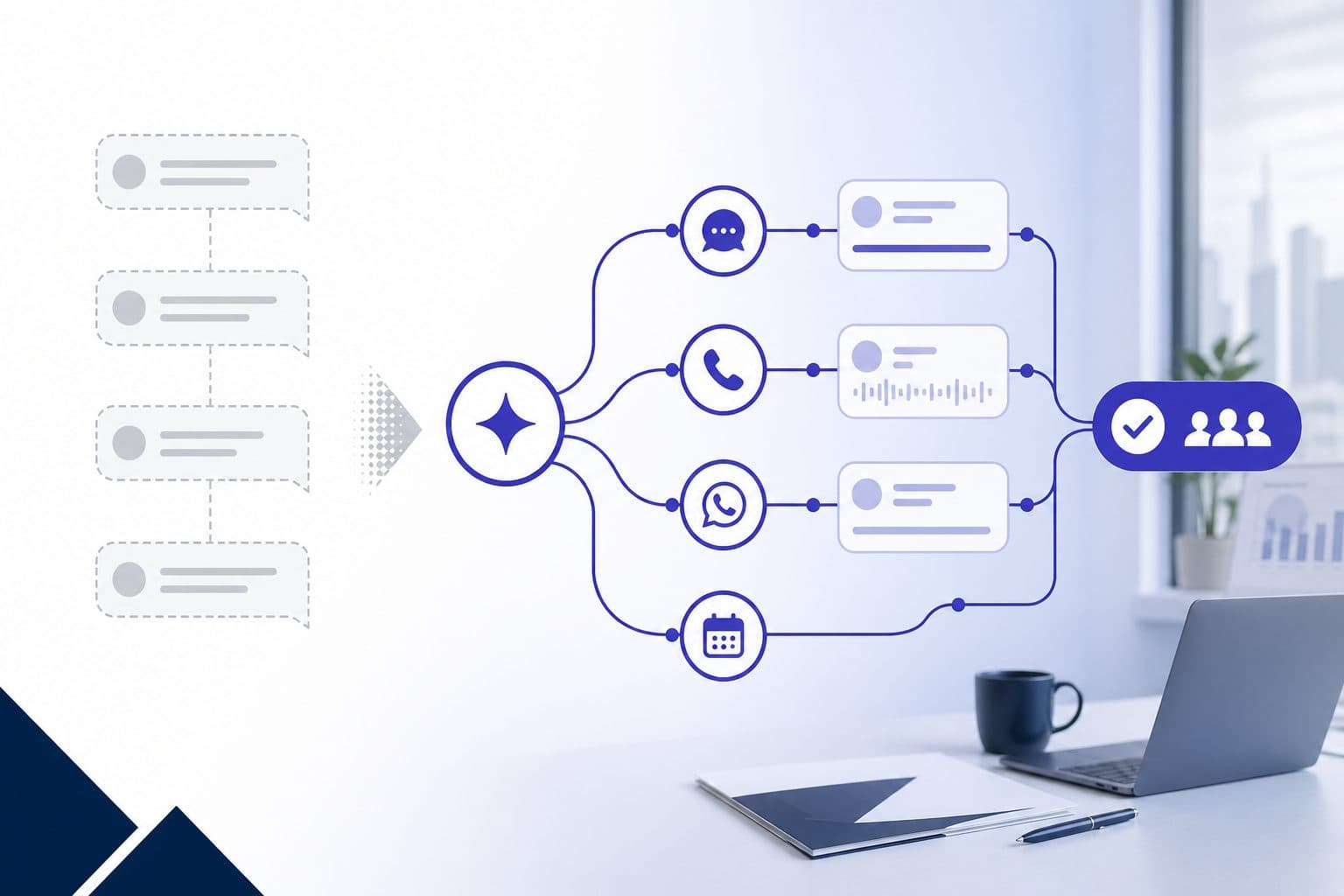
AI agents reason from buyer intent, make context-based decisions, take action across connected systems, and manage multi-step workflows. The core difference between AI agents and chatbots comes down to autonomy — chatbots respond; AI agents work toward a resolution.
High-ticket buyers expect a concierge experience. Most brands cannot deliver it at scale: inquiries pile up, context gets lost across voice, chat, and WhatsApp, and salespeople walk in cold. That is the gap Origa is built to close — remembering every buyer across channels, responding within minutes, and briefing your team before they pick up the conversation.
Understanding the difference guides better technology investments. The right choice depends on whether your sales and CX team needs simple conversational support, autonomous qualification and follow-through, or a mix of both.
More in this guide:
- What is an AI agent?
- What is an AI chatbot?
- Differences between an AI agent and an AI chatbot
- How to choose between an AI agent and an AI chatbot
- Frequently asked questions
What is an AI agent?
An AI agent is a goal-driven system that can plan, reason, and take action to complete a task. Instead of simply responding to a prompt, an AI agent evaluates context, decides what needs to happen next, and executes steps autonomously or with human oversight.
AI agents use large language models, business policies, buyer context, memory, and connected systems to determine the next best action. They can pull information from CRMs, product catalogs, inventory, and scheduling tools to personalise responses and complete tasks.
In high-ticket sales, an AI agent might qualify a buyer on a voice call, sync intent to the CRM, book a site visit or demo, and brief the assigned rep with full conversation context — without forcing the buyer to repeat themselves across channels.
AI agent use cases
More flexible than traditional chatbots, AI agents adapt when a buyer changes direction or information is missing. They can also accomplish tasks independently, so they are primarily used for multi-step qualification and autonomous workflow execution.
Some specific AI agent use cases include:
- Advanced autonomous qualification: Run discovery across voice, chat, and WhatsApp, score intent, and route only sales-ready buyers to your team.
- 24/7 concierge coverage: Respond within minutes in every time zone without adding headcount — Origa customers run on the order of 100K calls per month through this layer.
- Workflow orchestration: Prioritise, escalate, book, and coordinate follow-ups dynamically based on buyer intent, urgency, and deal context.
Across 33+ active customers in the UAE, India, and the US, deployments like this have driven an 18% qualification rate lift and 17.5 hours saved per rep each week.
What is an AI chatbot?
An AI chatbot is a tool that follows pre-defined rules to interact with customers. It is programmed to recognise keywords in messages and respond with scripted answers that guide users through a limited set of interactions.
Chatbots and conversational AI are sometimes used interchangeably, but there are differences in how each system understands intent, manages dialogue, and supports more natural interactions. Most chatbots rely on basic natural language processing to identify common phrases and match them to pre-built responses. As a result, they cannot personalise beyond what is explicitly programmed.
AI chatbot use cases
Chatbots excel at repetitive tasks that follow predictable patterns. They can answer common questions, collect basic information, and guide customers through simple workflows.
Typical use cases include:
- FAQs: Answer common questions on hours, pricing pages, return policies, or account settings.
- Scheduling: Guide users through booking a basic appointment or callback.
- Basic troubleshooting: Walk users through step-by-step solutions for common issues.
- Order or ticket status: Share status updates from a connected backend when the path is fixed.
For high-ticket sales, a chatbot alone rarely holds context across a multi-week buying journey. That is where agents — and a true concierge layer — become necessary.
Differences between an AI agent and an AI chatbot
The biggest difference is autonomy. Chatbots primarily converse with users. AI agents can reason through a goal, make decisions, and take action across connected systems.
This distinction affects how each technology handles buyer interactions, task complexity, quality assurance, knowledge, and adaptability.
| Dimension | AI chatbot | AI agent |
|---|---|---|
| Autonomy | Responds within a script | Plans and acts toward a goal |
| Memory | Session-limited or none | Cross-channel buyer memory |
| Task complexity | Simple, predictable flows | Multi-step, judgement-heavy |
| Systems | Limited lookups | Orchestrates CRM, voice, chat, WhatsApp |
| Learning | Manual script updates | Improves from outcomes and feedback |
Buyer interactions
AI agents create more adaptive sales interactions because they can maintain context, remember relevant details, and guide conversations toward a booked next step. They ask follow-up questions, respond to changing information, and proactively suggest next steps based on intent.
Chatbot interactions are usually more transactional. Because many chatbots follow scripted paths, buyers may need to rephrase questions or restart the conversation when their request falls outside the expected flow.
Quality assurance
AI agents can strengthen quality assurance by monitoring resolution quality, policy adherence, escalation risk, and buyer sentiment in real time. That gives sales leaders more visibility into how automated and human-led conversations are performing.
AI chatbots usually support QA in more restricted ways — structured feedback, simple sentiment checks, or satisfaction surveys — without the same visibility into conversation dynamics and outcomes.
Task complexity
AI agents manage complex tasks that require judgement, context, and multiple steps: interpreting the buyer's goal, clarifying constraints, taking action across systems, and adjusting when new information changes the path.
AI chatbots are better suited to simple tasks with fixed rules and predictable outcomes. They work well for FAQs and guided flows, but struggle when a request requires flexibility or coordination across systems.
Scope of knowledge
AI agents synthesise information across knowledge bases, buyer profiles, policies, and connected business systems. They do not just retrieve answers — they use the information to execute workflows like updating a CRM record, checking inventory, or booking a visit.
AI chatbots rely on a more limited set of predefined knowledge sources. When a question falls outside those boundaries, they may provide a generic answer or require a human handoff.
Learning and adaptability
AI agents improve through outcome optimisation. They analyse signals like qualification success, escalation patterns, customer feedback, and quality scores to identify what is working.
AI chatbots are typically more static. Updates often require manual rule changes, new scripts, or additional training data before the chatbot can handle a new topic.
Origa customers see a 28% CSAT improvement when every buyer is remembered across channels and every handoff arrives with a full brief — not a blank slate.
How to choose between an AI agent and an AI chatbot
As AI in sales and customer experience becomes more common, teams face a decision: do you need a simple tool to automate routine questions, or a more advanced solution to handle full conversations and actions autonomously?
The answer depends on your goals, resources, and the experience you want to deliver. Factors to consider:
- Determine your goals: If you need end-to-end qualification, booking, and personalisation for high-ticket deals, an AI agent is the better fit. If you only need to deflect basic questions, a chatbot may be enough.
- Evaluate your budget: AI agents offer greater long-term value by reducing escalations and saving rep time across complex workflows. Chatbots are generally cheaper to implement for narrow use cases.
- Decide on your ideal buyer experience: Chatbots offer fast support for predictable needs. AI agents provide adaptable, personalised interactions for buyers who expect a concierge.
- Weigh data privacy: Because AI agents access more data and systems, choose a provider with enterprise-grade security and clear governance — Origa is built for that bar across regulated verticals.
These tools are not mutually exclusive. Many businesses combine chatbots for simple deflection with AI agents for the conversations that close revenue.
Put AI to work in high-ticket sales
Choosing between an AI chatbot and an AI agent depends on your business needs. Chatbots are useful for simple, scripted interactions. AI agents can orchestrate workflows, take action, and resolve more complex buyer journeys across systems.
Origa is the AI concierge layer for high-ticket sales — remembering every buyer across voice, chat, and WhatsApp, responding within minutes, and briefing your team before they pick up the conversation. Book a demo to see it on your pipeline.
Frequently asked questions
Origa Team
Product & GTM
Origa is the AI concierge for high-ticket sales — remembering every buyer across voice, chat, and WhatsApp. Backed by Antler, with offices in Dubai, Bengaluru, and Palo Alto.